
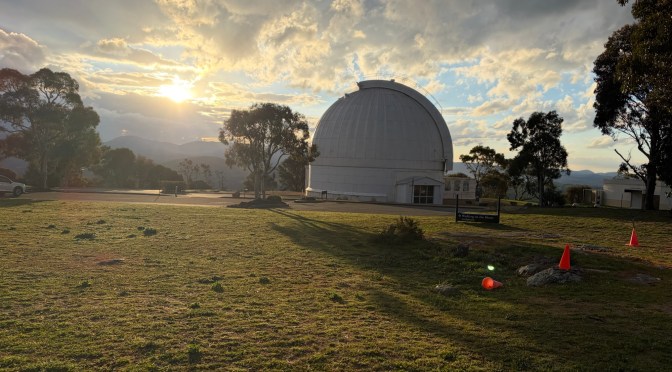
S2S?
One of the most valued aspects of SOTA as an award program has always been the S2S or “Summit to Summit” score, earned by making contacts with other summits when you are yourself on a summit.
The S2S award basically gives you whatever activation points you earn for the activation Plus the hunter points you earn by making the contact with the other summit. Ie. it’s the sum of the activation and chaser points for that contact on that date. If you’ve already activated your summit in the current year, you won’t earn activator points (unless you earn bonus points for activating in a bonus period). If you have already chased the other summit today, you won’t earn chaser points again for that summit. But otherwise, and the usual situation is that you earn your activator and chaser points in an S2S score for the contact.
I recently reached a S2S score of 10,000 and that was something not many other Australians have done yet. It has taken 13 years.
However once in the habit of looking out for activations planned by others, it is a hard habit to lose, especially when I have an easily reached summit within 10 km of where I live. So today I noticed in the alerts page that Compton VK2HRX was driving from Sydney down the Hume Highway and near Yass he was going to activate Mt Mundoonen. I planned a lightning raid at Mt Stromlo in response to this but it turned out that a few Czech activators were also planning an activation and it was occurring within a short time of Compton’s alert. So the afternoon turned into a quick contact with Compton on 144.2 MHz followed by a few lazy contacts on 40m, including a few parks contacts and another s2s with vk3bcm on a SOTA summit in Victoria. Then some contacts with Europe on 20m.
Comparison of quansheng with 857d
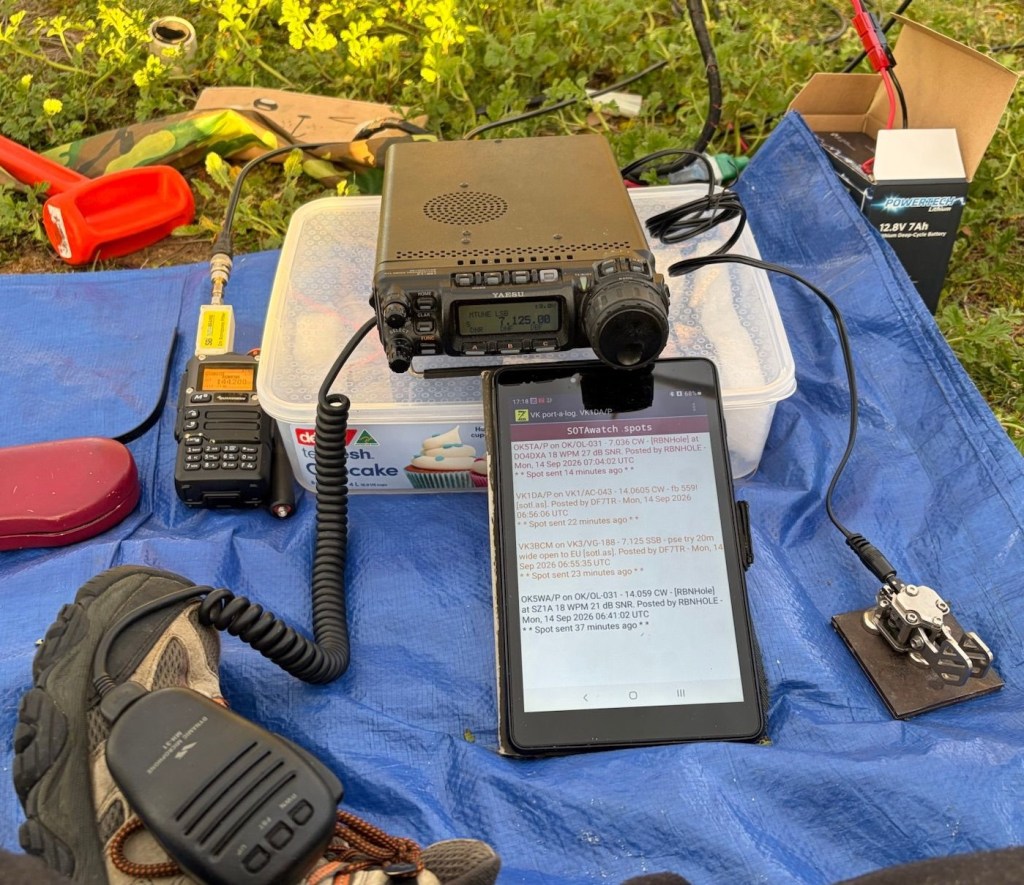
When I had worked Compton on 144 ssb with the ft857d I asked him to listen for my recently acquired hand held radio, a Quansheng UV-k5 modified for double sideband operation, both transmitting and receiving. Rated at 5w of FM output, the maximum it was producing was probably 5 watts of DSB, so each sideband would be 2.5w maximum. I did not know how well the receiver worked and I thought a comparison with the Yaesu FT857D I have been using on 144 ssb would be useful.
Using the same antenna, an hourglass, I received Compton’s signal at s9+ over the 54 km distance from Mt Mundoonen to Mt Stromlo. Swapping from the 857d to the Quansheng, I received an s9 report for the upper sideband when transmitting and on receive, his signal indicated s9 on the signal strength graphic display on the Quansheng. This indicates to me that the Quansheng is no mere toy radio especially when its firmware is patched to work on DSB (and CW, but I haven’t tried transmitting on cw yet).
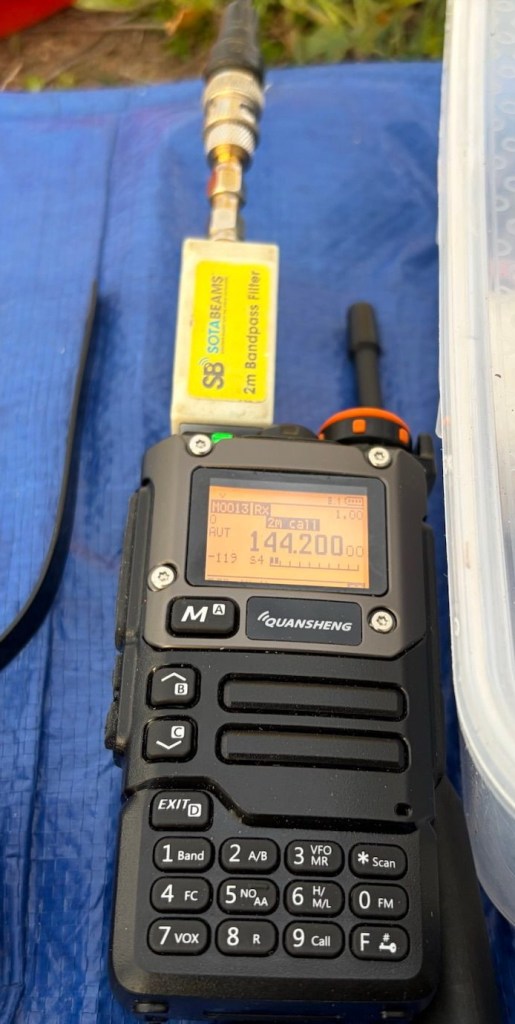
Note though, in series with the antenna cable plugged into the Quansheng I did insert a passband filter to filter out of band signals, as these small radios do not have selective RF stages and are susceptible to interference and blocking when near high powered broadcast and other transmitters. Similar blocking and overload problems occur with most wide coverage HTs and the filters are designed for use with such radios. I bought the filter several years ago from portable radio specialist SOTABEAMS in the UK.
Listening to the DSB signal transmitted by this radio it is clear that the carrier suppression is nowhere near the standard of the usual amateur radio gear, ie. better than 45-50 db. Instead it is probably only around 15-20 db of carrier suppression. Also, when using the up/down keys to move up and down in frequency across a USB signal, it is clear that there is no selectivity in the usual sense, because it will receive a signal on the LSB side of the suppressed carrier. The bandwidth I selected was the minimum, which was 6 or 8 khz. Within the limitations imposed by this wide bandwidth and lack of opposite sideband rejection, this is still a viable radio to use for short distance contacts and is light enough to carry in a shirt pocket or backpack.
Back to the activation.
20m
After making a few contacts on the 7 mhz band I switched up to 14 MHz and listened to the usual areas on the band where I make contacts with European operators near our sunset and their sunrise. At our sunset the path used for such contacts is the long path, ie. it is an easterly path from south east australia sweeping across the south Pacific to South America and up over the Atlantic ocean reaching Europe from the west.
The reason that path is effective at that time of day is that much of that path is in darkness at that time. The other shorter path is mostly sunlit and that affects the propagation of the signals such that the long path signals are more effective than the short path on that band. The two paths form a complete circle if joined up, the long path is 180 degrees opposite to the short path. Minor anomalies can occur if the path goes too close to the south or north pole but otherwise the 180 degree path difference is correct. Try using a piece of string on a globe joining two places on the globe if these concepts seem wrong to you. The shortest length of string joining those places is the straight line, the short path. The only other straight line path joining the two places joined by the string is the exact opposite path.
Log for 20m
So my log for this activation on 14 MHz contains the following contacts:
OK5WA Czech Republic
JG0AWE Japan (one of a few that were not in Europe)
DF9DX Germany,
S54X Slovenia,
DL6MST Germany
UA3T Russia
OK2PDT Czech Republic
ZL1IM New Zealand (Ian whom I met in New Zealand)
ON7GB Belgium
OK1KT Czech Republic
DJ2MX Germany
JS2TNW Japan
DL9NCI Germany
F4HZR France
OK1MGW Czech Republic
VK5CZ South Australia (another Ian, whom I met when on my trip to Uluru)
F5MQU France
GW0PLP Wales
EA5IW/P Spain
EA7GV Spain
OK5TA Czech Republic
DL8DXL Germany
DK0PT Germany
DF7TR Germany – this operator rode his bike for 50 minutes to get to where he could have this contact. He contacted me via my phone messaging afterwards to thank me for this contact.
G3VXJ England
These contacts were all made using the CW mode, a transmitter set to 50 watts output and a wire antenna mounted on a 7m fishing pole.


You must be logged in to post a comment.